



Key Takeaways
- Card outcomes are generated through a Random Number Generator tested across millions of rounds;
- Independent auditors review payout percentages separately from internal testing;
- A dedicated security team actively investigates bots, RTA software, and collusion;
- Full hand history and game results remain available to review at any time;
- Disputes are handled through direct contact with support and the security team.
Take a look at how the fairness system works and play with confidence knowing every hand is independently verified.
The Technology Behind Random Card Distribution
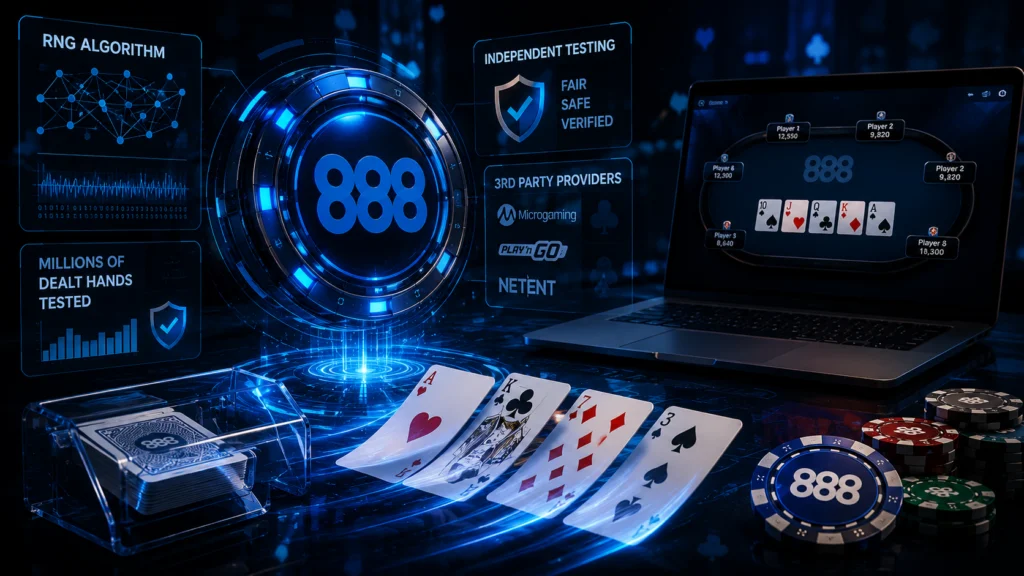
Every hand dealt at 888 Poker runs through a Random Number Generator built specifically to remove any predictable pattern from card distribution. Since the platform’s own “dealer” is a computer rather than a person for standard cash games and tournaments, this RNG carries the full weight of ensuring outcomes stay fair and unbiased. The system has been tested by running through millions of rounds and closely examining the results, rather than relying on a single initial certification and leaving it at that. Third-party game providers featured on the platform undergo their own separate in-house testing as well, including RNG-specific checks, adding another layer of scrutiny beyond what the operator runs internally. These measures help maintain a fair environment for players using 888 Poker online across all supported devices.
Independent Testing and Certification
Fairness isn’t something players are simply asked to accept at face value – the underlying systems go through structured, ongoing verification. Independent, internationally recognised testing bodies audit the RNG used for card distribution, with certification requiring periodic re-testing to stay valid rather than being a one-time stamp of approval. Separately, the platform retains independent auditors specifically to review payout percentages, keeping that oversight distinct from the RNG testing process itself. On top of this, every player has access to a complete log of their own game results, covering amounts wagered, outcomes, and transaction history, viewable at any time through the account or customer support.
Preventing Collusion Between Players
Random shuffling only covers part of what makes a game fair – the other half depends on players not gaining an unfair edge through outside coordination. 888poker maintains a dedicated internal security team focused specifically on detecting bots, real-time assistance software, and collusion between accounts. A few practices support this ongoing effort:
- Continuous monitoring of gameplay patterns for suspicious or coordinated behaviour;
- Investigation of accounts flagged through both internal detection and player reports;
- Permanent bans issued for accounts confirmed to be using prohibited software or working together;
- Refunds distributed to affected players once cheating is confirmed and investigated.
Player reports play a meaningful role in this process too, since the security team relies partly on the community flagging behaviour that looks off at the tables.
How Disputes Over Fair Play Are Handled for Players in Canada
Occasionally, a Canadian player may want to raise a concern about a specific hand or a suspected case of collusion at their table. In these situations, the game results log tied to the account can be pulled up and reviewed as a starting point, since every hand’s details remain accessible after the fact. Reaching out to support with the relevant table and hand information is typically the fastest way to get a specific concern properly investigated by the security team, particularly for anything involving suspected bots or coordinated play between accounts.
| Concern Type | Where to Start | What Gets Reviewed |
| Suspected RNG issue | Game results log | Hand outcomes and history |
| Suspected collusion | Support with hand details | Player accounts and betting patterns |
| Payout accuracy | Independent audit reports | Payout percentage data |
| General dispute | Customer support | Full account and session history |
